
How Long Does a Concrete Driveway Last in Florida?
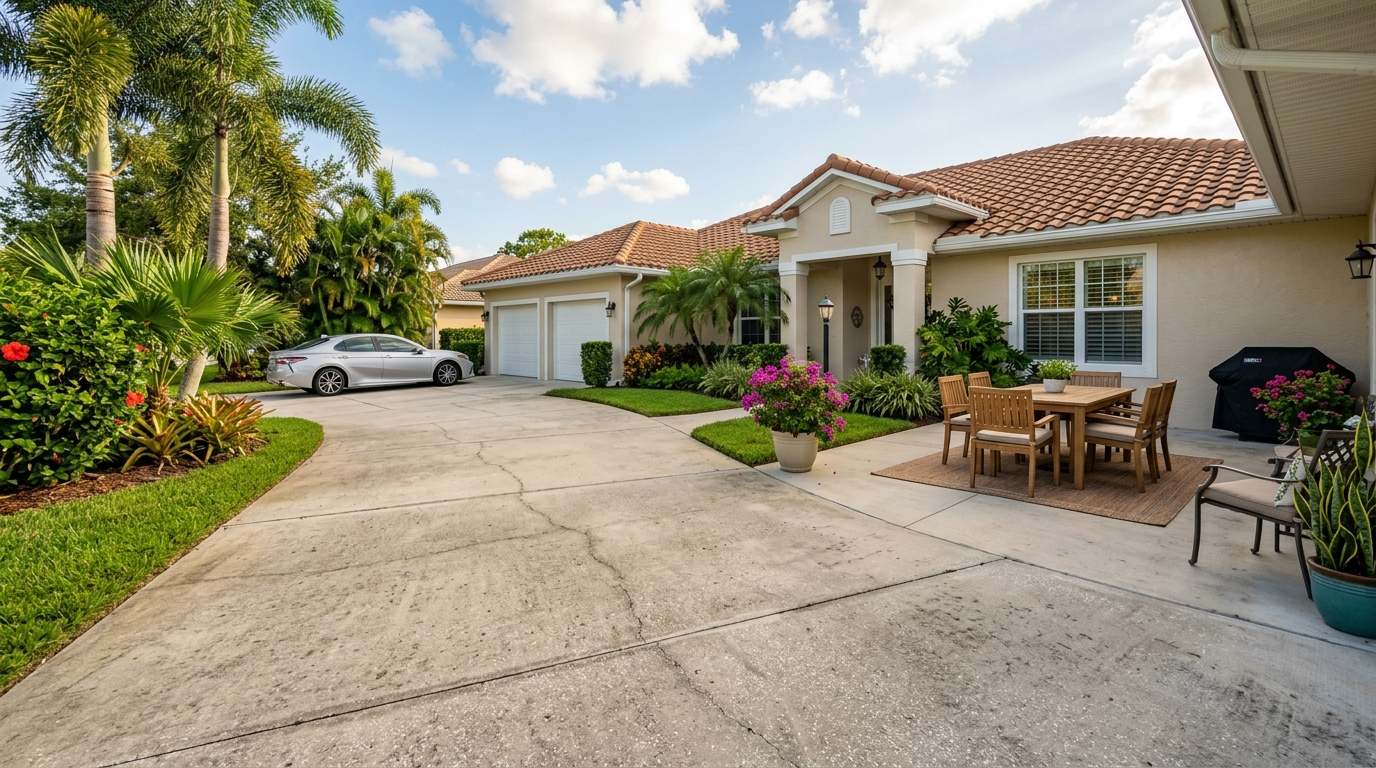
The average concrete driveway installed by a qualified contractor lasts 25–40 years in Florida — but the range around that average is wide, and Oakland Park homeowners who understand what drives longevity can extend their driveway’s life significantly. Equally important: knowing what shortens it helps homeowners recognize when a contractor is cutting corners that will cost money later. In this post, we cover the specific factors that determine concrete driveway lifespan in Broward County’s climate, what a proper maintenance schedule looks like, and how to tell when a driveway has reached the end of its repair-worthy life.
Concrete Driveways Built to Last in Oakland Park
Oakland Park Concrete Pros installs to the 6-inch/3000 PSI/limerock standard. Free estimates — call (888) 376-0955.
Why Concrete Lifespan Varies in South Florida
A concrete driveway in Oakland Park faces environmental stresses that a driveway in Phoenix or Denver doesn’t. South Florida’s combination of high UV, frequent wet-dry cycles, high water table, and occasional hurricane-force wind loading creates conditions where the installation quality matters more than the base material.
The difference between a 15-year and a 35-year concrete driveway in Oakland Park often comes down to three decisions made during installation: base depth, concrete strength, and drainage design. Driveways built to Oakland Park’s permit specification — 6-inch minimum thickness, 3000 PSI concrete, 8-inch limerock base compacted to 95% — consistently outperform those that compromise on any of these parameters. This isn’t theory; it’s the pattern we observe when assessing older driveways in Lloyd Estates, Royal Palm Acres, and North Andrews Gardens neighborhoods.
What Shortens Concrete Driveway Life in Oakland Park
Inadequate base preparation: Oakland Park’s Broward series sandy marine soil requires an 8-inch limerock base because the water table at 18–30 inches means the soil below the base goes from load-bearing to weakened every wet season. A driveway on a 4-inch base instead of 8-inch will show cracking from sub-base movement within five to seven years.
Under-strength concrete: 2500 PSI concrete poured instead of 3000 PSI reaches the edge of its thermal-expansion and load-bearing capacity faster in South Florida. The difference in material cost is small; the difference in lifespan is measurable.
No sealing: Florida’s UV index reaches extreme levels for extended periods each year. Unsealed concrete absorbs UV radiation, breaks down the cement paste, and begins surface scaling within five to seven years. Sealing every two to three years interrupts this degradation cycle before it becomes structural.
Poor drainage design: Concrete driveways that drain toward the house, toward a neighbor’s property, or that pool water in low spots create ongoing sub-base erosion. Every wet season, water sitting on or against the slab edge works through cracks and erodes the limerock base. Proper drainage design at installation is the most cost-effective long-term investment in driveway longevity.
Tree root intrusion: Oakland Park’s established residential canopies — particularly in Coral Heights and Garden Acres — have mature root systems that grow toward moisture. Roots beneath a driveway exert upward pressure that cracks concrete from below. Root barrier installation at the time of construction extends driveway life in heavily treed yards.
What Extends Concrete Driveway Life in Oakland Park
Regular sealing: Sealing every two to three years protects the surface from UV degradation, prevents moisture infiltration into the slab body, and makes the surface easier to clean. This is the single highest-return maintenance investment for Oakland Park concrete driveways.
Prompt crack repair: Small cracks that are filled when they’re narrow (1/4” or less) prevent water from reaching and eroding the limerock base. Cracks that are allowed to widen to 1/2” allow water infiltration that undermines the base, leading to settlement and further cracking.
Proper drainage maintenance: Keeping drains clear, maintaining downspout extensions, and ensuring the swale functions properly around the driveway perimeter prevents the sustained water contact that accelerates both base erosion and concrete surface scaling.
Avoiding heavy vehicle loading: Passenger vehicles and light trucks are within the design load for residential driveways built to Oakland Park’s code. Repeated heavy vehicle loading — concrete delivery trucks, moving trucks, large equipment — can exceed the design load, particularly on new concrete that hasn’t reached full 28-day strength.
Practical Uses for This Information
- Evaluating a home purchase: A concrete driveway that’s cracking at joints, showing widespread surface scaling, or is clearly settled in sections may be approaching replacement. Ask about installation date and permit history — a permitted driveway built to code should be repairable; an unpermitted driveway of unknown specification may not be worth repairing.
- Planning maintenance scheduling: Start sealing within six months of installation and reseal every two to three years. In Oakland Park’s UV environment, two years is the conservative end of the range for exposed driveways in full sun.
- Evaluating repair vs. replacement: A driveway with surface-level cracking, some spalling, and minor settlement in one section is a repair candidate. A driveway with full-depth cracking across multiple sections, significant overall settlement, and sub-base erosion visible at crack edges is a replacement candidate. Our concrete repair page covers the assessment criteria in detail.
Is Your Oakland Park Driveway Worth Repairing or Time to Replace?
Oakland Park Concrete Pros provides honest assessments — free, no-obligation, no pressure. Call (888) 376-0955.
Maintenance Timeline for Oakland Park Driveways
Year 1: Allow full 28-day cure before heavy vehicle use. Apply penetrating sealer at 60–90 days after installation.
Years 2–3: Inspect for any settlement or cracking. Reseal if the surface shows water absorption rather than beading.
Years 3–5: Second sealing application if not done at two years. Address any cracks larger than 1/8” with crack fill before they widen.
Years 10–15: First significant maintenance decision point. Driveways with surface-level cracking and spalling may be candidates for resurfacing overlay ($3–$7/sqft) rather than replacement ($8–$12/sqft). Evaluate drainage and base condition through any cracks visible.
Years 20–30: Second significant decision point. Driveways with proper base installation, regular sealing, and prompt crack repair often remain in good structural condition at 20 years. Cosmetic deterioration (surface scaling, color fading) doesn’t mean the driveway needs replacement if the base is sound.
Cost Factors
Maintaining a concrete driveway in Oakland Park costs $300–$500 for two sealing applications over five years — a fraction of the $4,000–$6,000 replacement cost of a 500 square foot driveway. Crack repair at $200–$800 per event is similarly cost-effective when done promptly. The worst investment is deferring maintenance until a repair-worthy driveway becomes a replacement-necessary driveway through neglect.
Frequently Asked Questions
How long does concrete last in Florida before needing repair?
A properly installed concrete driveway in Oakland Park — 6-inch thickness, 3000 PSI, 8-inch limerock base — typically shows first surface wear after 10–15 years without sealing. With sealing every two to three years, surface integrity is maintained for 25+ years before significant repair is needed. The biggest accelerators of premature damage are poor drainage, inadequate base, and skipped sealer applications. See our concrete driveways page for installation specifications.
Does sealing really extend concrete life in South Florida?
Yes, significantly. Florida’s UV index reaches extreme levels year-round, and unsealed concrete absorbs this radiation directly. The cement paste breaks down, and surface scaling begins within five to seven years. A sealed surface reflects UV radiation and prevents moisture infiltration into the slab body. Sealing every two to three years is the single most cost-effective maintenance step for Oakland Park concrete. Read our best time to schedule concrete work for optimal seasonal maintenance timing.
When is it time to replace rather than repair a concrete driveway in Oakland Park?
Replacement is the right answer when: full-depth cracking spans multiple sections of the driveway, significant differential settlement has occurred (more than 1 inch between sections), sub-base erosion is visible through cracks or at edges, or the driveway is more than 30 years old and showing widespread structural deterioration. Surface-level cracking, spalling, and minor settlement are typically repair candidates. Our concrete repair assessment service helps Oakland Park homeowners make this determination accurately.
Protect Your Oakland Park Concrete Investment
Oakland Park Concrete Pros installs driveways built to last and can assess what your existing driveway needs. Call (888) 376-0955.
Related: