
Foundation Repair in Broward County: What Oakland Park Homeowners Need to Know
Most Oakland Park homeowners don’t think about their foundation until a door sticks, tiles crack in a line across the floor, or a diagonal crack appears at a window corner. At that point, the question is: is this cosmetic or structural, and how serious is it? The answer is almost always tied to Broward County’s specific geological conditions — conditions that affect foundation stability differently here than anywhere else in Florida. In this post, we cover how Oakland Park’s limestone bedrock, high water table, and seasonal soil movement create foundation issues, what repair options address each scenario, and when to call a professional.
Free Foundation Assessment for Oakland Park Homeowners
Oakland Park Concrete Pros provides honest evaluations — no repair obligation. Call (888) 376-0955 to schedule.
Why Broward County Foundation Repair Is Different
The geology beneath Oakland Park creates foundation conditions that change with every wet and dry season. Broward fine sand — the dominant soil type throughout Oakland Park from Lloyd Estates to Garden Acres — is extremely permeable. During Broward County’s June-through-October wet season, the water table rises into this sandy layer, which then loses the bearing capacity it had when dry. Slabs and footings that were supported adequately in the dry season now rest on weakened soil.
When the dry season begins in November and the water table drops, the sandy soil contracts — creating a void between the underside of the slab and the soil surface. This void remains until the next wet season refills it, during which time the unsupported slab section deflects under load and cracks. The cycle repeats annually, and the cumulative damage is what produces the cracking, sticking doors, and tile separation that Oakland Park homeowners eventually call about.
The limestone bedrock at 20–40 inches depth adds another dimension. Solution cavities — voids dissolved into the limestone by groundwater over thousands of years — can develop directly beneath footings. When a cavity undermines a footing, sudden settlement occurs. The Florida Geological Survey documents void-related foundation events across Broward County regularly.
Types of Foundation Issues in Oakland Park
Settlement cracking: The most common foundation issue in Oakland Park and throughout North Andrews Gardens and Twin Lakes South neighborhoods. Presents as diagonal cracks at window and door corners, stair-step cracks in concrete block walls, and tiles cracking across the floor in a linear pattern. Usually caused by differential settlement — different sections of the foundation settling at different rates.
Hydrostatic cracking: Horizontal cracks in below-grade foundation walls or in slab sections close to grade, caused by water pressure against the concrete from the high water table. Most visible after heavy rainfall events or at the end of Broward County’s wet season when the water table is at its peak.
Void-related settlement: Sudden, localized settlement caused by a solution cavity collapsing beneath a footing. Less common than settlement from soil movement but more dramatic in its presentation — a door that was fine last week won’t close today, and a section of floor has dropped a quarter inch.
Tree root intrusion: Oakland Park’s established residential canopies — particularly in Coral Heights and Royal Palm Acres — have mature root systems that grow toward moisture sources, including the moisture gradient at slab edges. Root pressure beneath or against foundation walls causes localized cracking that progresses as the roots grow.
How Foundation Repair Works
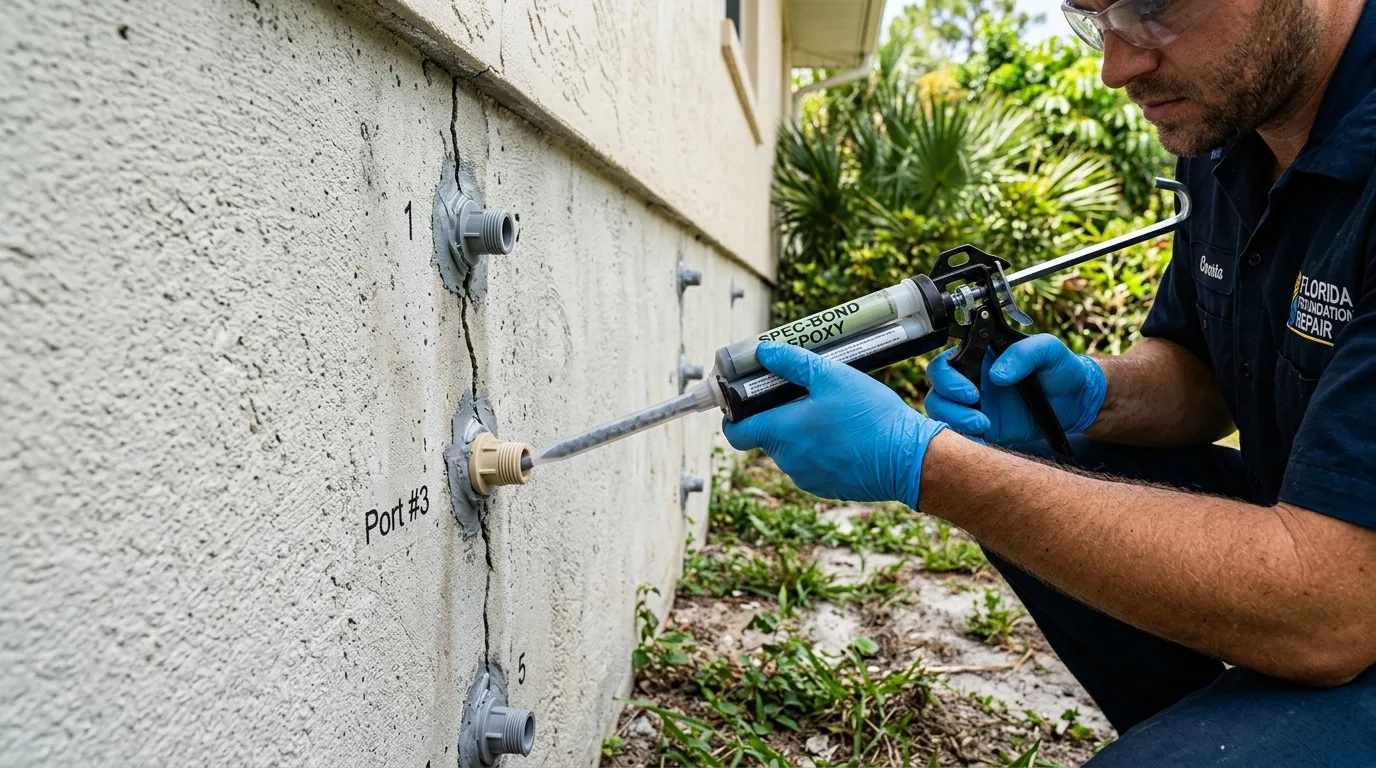
Crack injection: For stable cracks that have stopped moving — typical in older Oakland Park homes where the settlement event happened years ago and equilibrium has been reached — epoxy injection fills and bonds the crack, restoring structural continuity. For cracks that may still be subject to moisture movement, flexible polyurethane injection is used instead.
Pier installation: For active settlement — where the foundation is still moving downward — helical or push piers are installed beneath the footings. The piers are driven through the sandy soil to the stable limestone bedrock below, transferring the foundation load to solid rock rather than the unstable sandy layer. Pier installation typically stops further settlement immediately and may allow partial lifting of settled sections.
Void grouting: For solution cavity-related settlement, pressurized grout is injected into the void to fill it and stabilize the surrounding soil before structural repairs begin. This is a specialized process requiring equipment and expertise beyond standard concrete repair.
Drainage correction: Often the most important repair element for Broward County foundation issues. If the drainage pattern around a home is channeling water toward the foundation — from roof downspouts, grading that slopes toward the house, or impermeable hardscape that prevents percolation — correcting it is essential to preventing recurrence.
Oakland Park Foundation Assessment — Honest, No Pressure
We identify the root cause before recommending any repair. Call Oakland Park Concrete Pros at (888) 376-0955.
Practical Uses for This Information
- Distinguish cosmetic from structural: Hairline cracks in stucco that don’t penetrate the underlying block or concrete are cosmetic. Cracks that open through the full wall thickness, that change width over time, or that appear at structural stress points (corners, above openings) require professional evaluation.
- Document cracking over time: Photograph cracks with a ruler for scale, dated. Return in three months and compare. Cracks that don’t change over two dry-season months are likely stable. Cracks that widen or lengthen are active.
- Check the drainage first: Before calling a foundation repair specialist, walk around your home after a heavy rain. Water pooling against the foundation, downspouts discharging at the foundation perimeter, or grading that slopes toward the house are drainage problems that will continue to drive foundation damage regardless of what structural repairs are made.
- Get a second opinion for large scopes: Foundation repair estimates vary significantly. A pier installation scope for a Lauderdale Lakes or Wilton Manors home comparable to an Oakland Park property should come in within 20–30% of competing estimates for similar work. Outlier quotes — very high or very low — warrant investigation.
Cost Factors for Foundation Repair in Oakland Park
Crack injection for stable residential foundation cracks: $500–$3,000 depending on crack length and depth. Pier installation: $1,000–$3,000 per pier — most Oakland Park homes with active settlement require three to ten piers, putting total scope at $3,000–$30,000. Drainage correction adds $1,500–$5,000. Void grouting for limestone cavity-related settlement: $3,000–$15,000 depending on void volume and access.
The breadth of these ranges reflects how variable foundation issues are. An on-site assessment is the only way to arrive at accurate numbers for any specific Oakland Park property.
Frequently Asked Questions
What causes foundation cracks in Oakland Park specifically?
Oakland Park’s foundation cracks are most commonly caused by Broward County’s seasonal water table fluctuation: the water table rises during the June-through-October wet season, saturating the sandy soil and reducing its bearing capacity; the water table drops in the dry season and the soil contracts. This annual cycle drives differential settlement that produces the cracks homeowners see. See our foundation repair service page for repair options.
Is foundation repair in Broward County worth the cost?
For active settlement — where the foundation is still moving — foundation repair prevents ongoing damage to the structure and its finishes. Untreated active settlement compounds over time, eventually requiring more extensive and expensive repair. For stable, old cracks that have reached equilibrium, the decision is more nuanced — crack injection may be worth it for water exclusion and appearance, but isn’t urgent for structural reasons. Our free assessments help Oakland Park homeowners understand which situation they’re facing. See our concrete repair page for surface repair options.
Do I need a structural engineer for foundation repair in Oakland Park?
For pier installation and other structural foundation work, Broward County typically requires permitted engineering drawings. Some repair contractors work with licensed structural engineers to produce the permit drawings required. For crack injection and other non-structural repairs, engineering drawings aren’t typically required. We advise on engineering requirements during the assessment process for each project.
Don't Ignore Foundation Warning Signs in Oakland Park
Early intervention is always less expensive than waiting. Call Oakland Park Concrete Pros at (888) 376-0955 for a free assessment.
Related: